International Women's Day 2026: Meet the South West innovators overcoming barriers and driving change

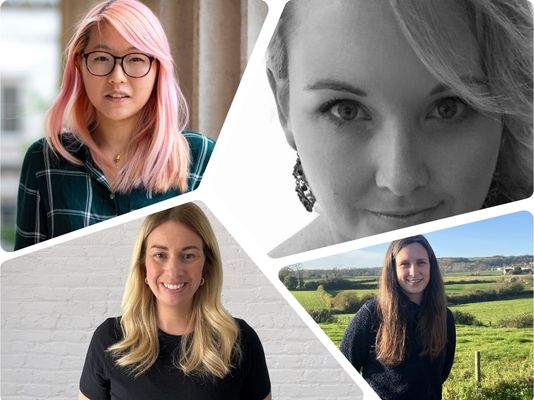
To mark International Women’s Day 2026, we’ve gathered insights from some of the most forward-thinking female innovators from across the South West. They share their experiences of overcoming gender barriers and driving the next generation of innovation in STEM businesses.
International Women's Day takes place each year on 8 March. It’s a global celebration of the social, economic, cultural, educational and political achievements of women and girls, while calling for the advancement of gender equality.
This year’s IWD theme is “Give to Gain”, encouraging us all to give donations, knowledge, resources, advocacy, mentoring and other things to help bring about gender equality and increase opportunities and support for women.
Women in Innovation Awards
Innovate UK has long embraced the Give to Gain concept through its Women In Innovation Awards, which celebrate and support women in business. Each year winners receive a £75,000 grant, personalised business coaching and access to networking and training.
Innovate UK research found that access to funding was the biggest barrier facing women innovators, while lack of visible role models and networks for women in innovation were also key challenges. The awards were launched in 2016 to address these issues directly.
Jane Pearce, CEO of Rookwood Operations, was named a Women In Innovation Award winner in 2025. Her pioneering business, based near Wellin Somerset, is transforming how phosphate is handled in water treatment.
Advice for women innovators
Speaking to Innovate UK, Jane says she was honoured and excited to win the award. “I’m hoping to extend my network of women innovators whose innovations and exceptional businesses speak for themselves, and together, become part of a movement that puts women innovators front and centre.”
She also highlights challenges she experienced while raising investment: “I’m sure the questions I was asked were different than if one of my male co-founders had pitched. This was quite disheartening, but in the long run, it’s their loss.”
Her advice for aspiring women innovators is to never give up. “Keep going. Keep talking about the challenges women face. Most importantly – keep succeeding – so you can show how great women are.”
Proudly representing women
Ying Lia Li, CEO and CTO of Zero Point Motion, won her Innovate UK Women In Innovation Award in 2023. The Bristol-based company develops chip-scale sensors that measure motion and rotation for cars, phones, robots and motion-capture wearables. “I experience different types of microaggressions ranging from being mistaken for the secretary to assumptions that I don’t understand my own technology,” she told Innovate UK upon winning the award. “Society does not naturally accept a woman as the CEO of a deep tech hardware company – let alone someone with pink hair!
“I’ve been fighting various stereotypes and am proud to represent women in STEM and R&D, especially when I was working in the defence industry and then as an academic physics researcher. A big challenge is maintaining my role as a CEO.” As Lia points out, although women make up about 43% of FTSE 100 company boards, they include only nine women CEOs.
Lia adds: “I’ve learned not to let imposter syndrome prevent me from becoming a confident leader, and to be proud of how far I’ve come, which is far beyond the dreams I had when I was a kid.”
Wave of positivity
Laura Duggan is the CEO and Co-Founder of Fetch Energy, a developer of next generation wavepower technology. She says she’s been fortunate to know some incredible women who have given much in many ways. “One of the things I find great about women in general, and specifically in this sector, is their willingness to share networks, learnings and advice.”
Laura says it’s sometimes difficult to determine whether she’s encountered gender bias, although very occasionally it's obvious. “In most cases you might have a sense that it's happening, but it's very hard to pin down,” she adds. “At the end of the day, I could spend my energy worrying about if I'm facing bias, but that just wouldn't help me, the team or Fetch.
“I can't control whether others have bias, but I can focus on building the best business I can with my co-founder and team. I’m also working to make sure that we’re conscious about representation and inclusion, not just gender, as we build our own culture at Fetch.”
Gender inequality in business
Anna Studley is Operations Manager at Latent Drive, a UK clean energy technology company developing next generation electrolysis systems to make green hydrogen cheaper and easier to produce at scale.
She says clean energy remains a largely male-dominated sector, especially in senior and technical roles. “I’ve been the only woman in the room and at times have felt I’ve needed to work harder to prove my credibility. When leadership and networks are predominantly male, it’s easier for opportunities to circulate within those same circles. That can mean women are sometimes overlooked for roles or projects, even when they are equally – or better – suited to them.”
Misguided gender-based assumptions about competence, seniority or who should take the lead in a room still exist, she adds. “Over time, I’ve learned to be more prepared, clear and confident in my expertise, and I’ve become more comfortable addressing assumptions directly when needed,” she states.
Time for change
Skye McNeill is Chief Operating Officer at Crowd, an innovation-driven marketing communications agency. She believes leadership culture needs to change at many organisations. “True leadership is about discarding the top-down, rigid approach to management.
“It’s the ability to adapt your style to the individual, ensuring every person feels respected and heard. When you involve your team in the 'why' behind the journey and remember the power of a simple 'thank you’, you don't just lead a team, you build a community."
Anna Studley would like to see more support for women at every stage of innovation. “Access to capital, networks and sponsorship still isn’t equal and that determines who gets to build and lead the next generation of businesses,” she says. “Flexible working and inclusive cultures should be standard, not exceptional. More importantly, I’d like to see more women stepping into senior and decision-making roles – not as the exception, but as part of the norm.”